
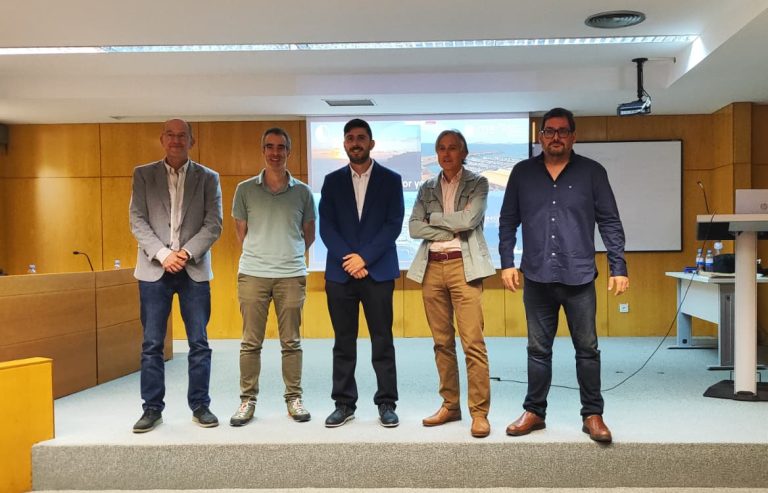
On 3 June 2026, QAISC researcher Jonay Suárez Ramírez successfully defended his doctoral thesis, Efficient Deep Learning Vision for Coastal and Maritime Surveillance, receiving the highest possible grade, Sobresaliente Cum Laude.
Nelson Monzón supervised this doctoral research, which Jonay developed as part of his academic work at QAISC in collaboration with the ULPGC.
Coastal environments present demanding conditions for artificial intelligence systems. Reflections on the water, sea foam, changing illumination, and weather variations can significantly degrade the performance of standard vision models.
At the same time, many systems designed for coastal and maritime surveillance must operate on embedded hardware in remote locations with limited network connectivity. This research directly powers QAISC’s ability to address these specific constraints, delivering methods to extract reliable, real-time information from video streams under strict computing, latency, and bandwidth limitations.
The doctoral thesis approaches these environmental and technical challenges through three complementary research areas.
The first area analyses how the choice of model and the definition of semantic classes influence the quality of the information extracted from coastal images. By distinguishing between visually similar but functionally different elements, such as sea foam and wet sand, the resulting segmentation supports key applications. These include coastline and region extraction, intertidal-zone estimation, and wave-overtopping detection.
The second area examines the efficient detection of small objects in wide maritime and coastal scenes. Instead of processing every part of a high-resolution image with the same level of detail, the proposed methods identify the most informative regions. This approach concentrates computational resources where they are most needed, providing solutions for personal protective equipment monitoring, as well as the VIGIA-E and DAHI strategies, which use object-density information to perform targeted high-resolution inference.
The final contribution integrates segmentation, object detection, and temporal analysis into SEATrack, a maritime tracking system designed to operate entirely on embedded GPU devices. By concentrating processing on relevant maritime regions and using different image resolutions, the system improves the tracking of distant vessels. Furthermore, it transmits compact metadata instead of full video streams, providing an important advantage in locations where network bandwidth is limited.
Ultimately, this research reflects QAISC’s core strategy: translating cutting-edge academic innovation into market-ready solutions. These results are already contributing directly to QAISC’s highly efficient computer vision systems for coastal monitoring, maritime surveillance, and industrial safety.
This major academic milestone follows Jonay’s previous international collaboration as a visiting scholar at Rutgers University, where he focused on advanced ocean observing programs and real-time monitoring.
The entire QAISC team congratulates Jonay on this outstanding achievement and on the excellent results of his doctoral research.

QUALITAS ARTIFICIAL INTELLIGENCE & SCIENCE


Copyright © 2024. Qualitas Artificial Intelligence & Science . All rights reserved.